Vansim (Dongguan)Hardware Products Co., Ltd.




How does the semiconductor cooling effect of the embedded copper tube liquid cold plate work?
The semiconductor cooling effect in an embedded copper tube liquid cold plate operates through the Peltier effect, a fundamental principle of thermoelectricity, combined with the high thermal conductivity of copper and the heat-carrying capacity of liquid cooling.
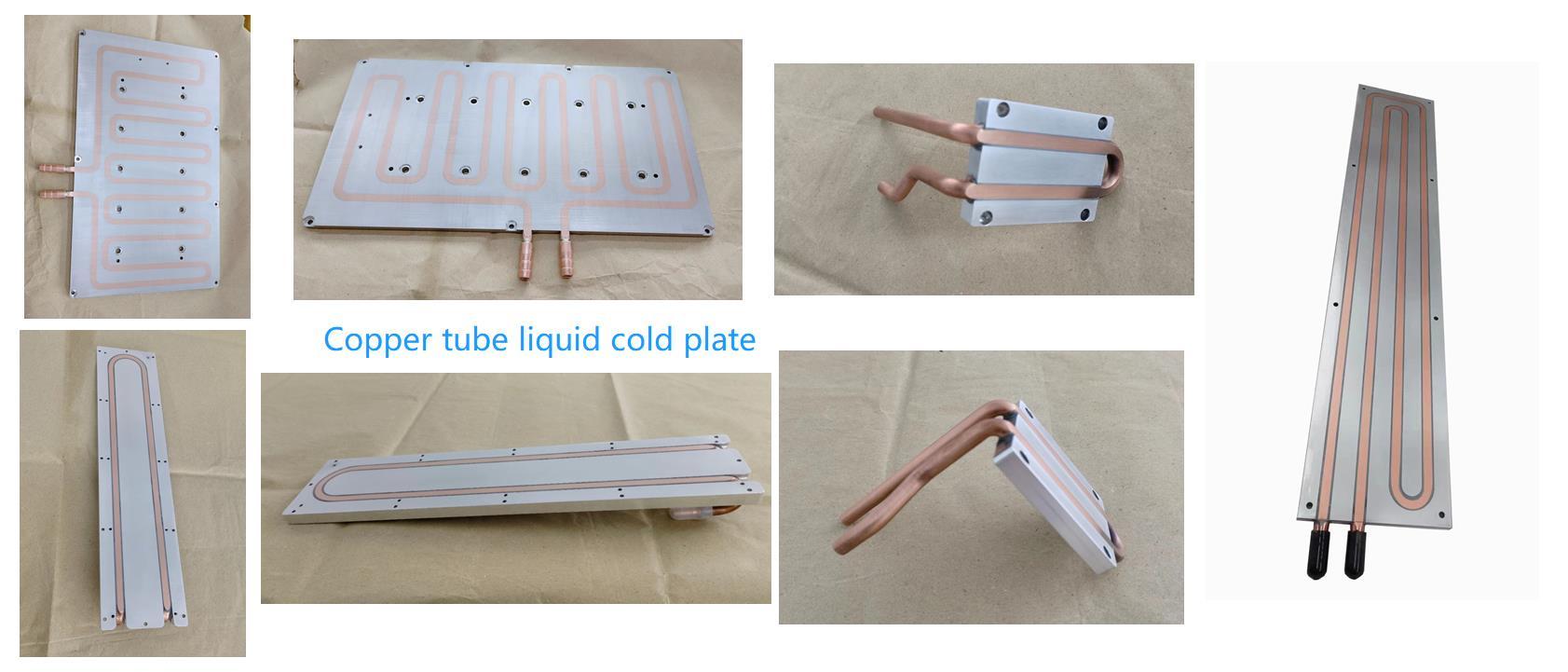
Integration with Copper Tube Liquid Cold Plate
A. TEC Cold Side: Heat Absorption
- The TEC’s cold side is directly attached to the heat-generating component (e.g., CPU, laser diode) using a thermal interface material (TIM, such as thermal grease or pads) to minimize thermal resistance.
- As the TEC absorbs heat from the component, the cold side’s temperature drops, creating a low-temperature zone that draws heat away from the source.
B. Copper Tube Liquid Cold Plate: Heat Transport and Dissipation
- Copper Tube Design: The cold plate contains embedded copper tubes (or micro-channels) filled with a coolant (e.g., deionized water, glycol). Copper’s high thermal conductivity (401 W/m·K) rapidly transfers heat from the TEC’s hot side to the coolant.
- Liquid Cooling Loop: The heated coolant flows through the copper tubes to an external heat exchanger (e.g., radiator or cold wall), where it releases heat to the environment. A pump maintains coolant circulation, creating a continuous heat-dissipation cycle.
 |  |
semiconductor cooling embedded copper tube liquid cold plate
Contact Us
Classification

// CONTACT US
Didn'T Find The Service You Want?
For inquiries about our products, please email to us and we will be in touch within 24 hours.
We Support Customization
Continue To Create Greater Value For Customers
Contact Us
No. 10, Minying West Road, Hengli Town, Dongguan City, China 523390